The Colombian Quantum Alliance (CQA)
“Uniting Minds, Entangling Futures”
1. The Vision Statement
To establish Colombia as a Hub for Quantum Information Science (QIS) by 2036.
We envision a future where Colombia does not merely observe the quantum revolution but actively participates in it. By leveraging our established strengths in High-Performance Computing (HPC) and our strategic “Triple-Helix” partnerships, the CQA will transition the nation from a consumer of foreign technology to a sovereign creator of quantum software, algorithms, and industrial applications.
2. The Strategic Mission
Our mission is to democratize access to quantum infrastructure, accelerate advanced workforce development, and foster the adoption of quantum solutions in national industry.
The Role of CyberColombia
It is crucial to clarify that CyberColombia acts as the Orchestrator and Community Enabler, not a hardware provider.
- We are the Glue: CyberColombia provides the human infrastructure (community, workshops, networking) that connects researchers.
- We are the Bridge: We do not own the Supercomputers or Quantum Processors; we negotiate and manage the access to them through our global partners (NCSA, SCALAC).
- We are the Catalyst: We lower the barrier to entry so that a student in Bogotá can run code on a machine in Illinois or Munich without bureaucratic friction.
3. The Ecosystem Architecture (The Stack)
The CQA model is defined by a “Leapfrog Strategy” focused on Application and Software, avoiding the heavy capital expenditure of hardware fabrication. The ecosystem operates in three distinct layers:
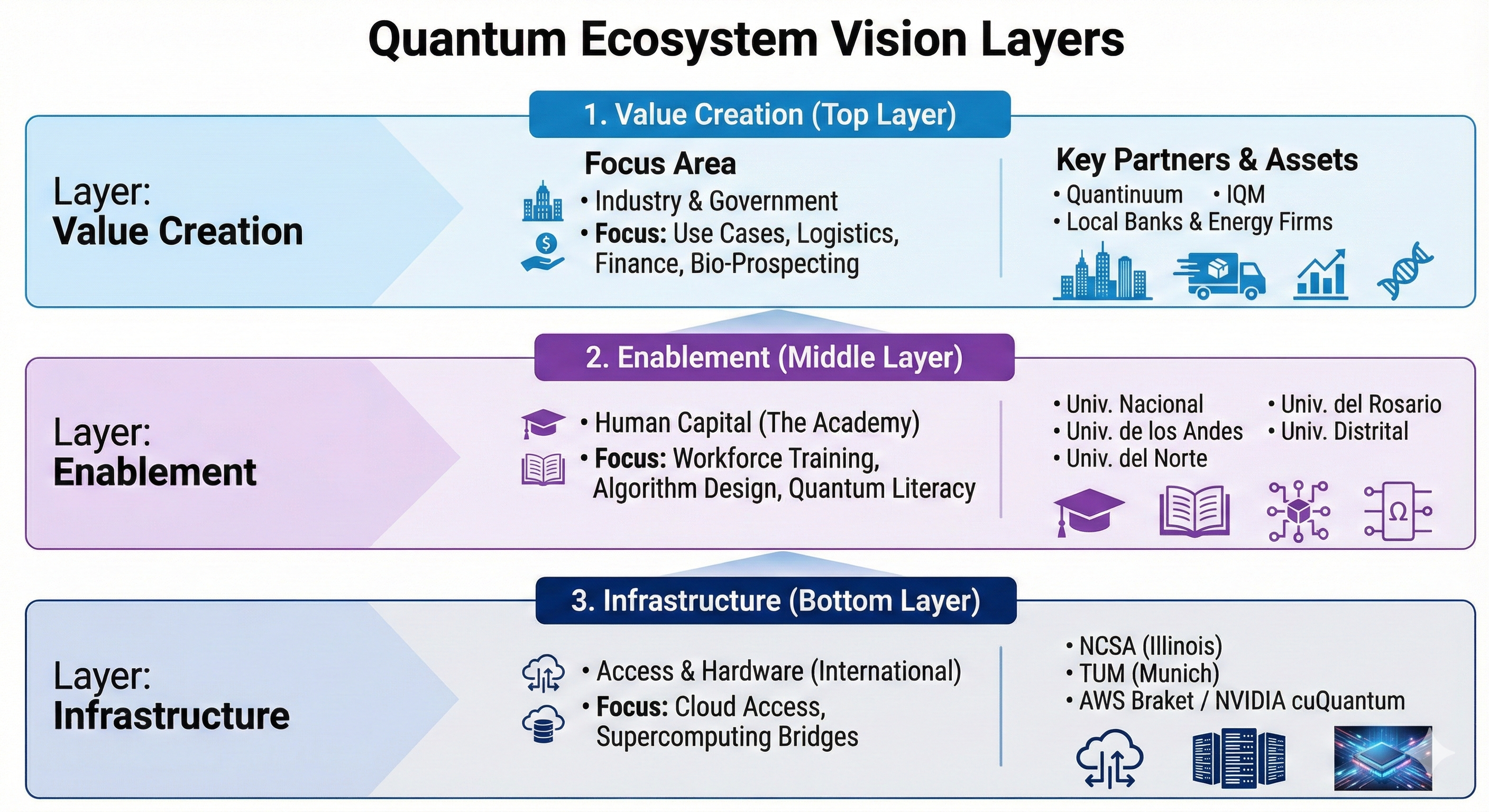
4. Comparative Ecosystem Analysis
To define our niche, we analyze our model against established US and European ecosystems. Our strategy is distinct because it is Asset-Light and Software-First.
A. Contrast with the European Model (Munich Quantum Valley - MQV)
Our partner TUM is a key player in the Munich Quantum Valley. However, our operating models diverge significantly due to regional industrial realities.
- The Munich Model (Hardware-Centric): MQV operates with a multi-billion Euro budget with a primary mandate to build quantum computers (Superconducting and Neutral Atom). Their ecosystem relies on proximity to high-tech fabrication facilities (clean rooms, cryogenics manufacturers) and a mature hardware supply chain.
- The CQA Model (Software-Centric): CQA operates as an “Algorithm Factory.” We accept the regional absence of hardware vendors (no local fabrication labs) not as a weakness, but as a constraint that forces strategic focus.
- Differentiation: We do not compete on “metal.” We compete on the Application Layer—the bridge between the hardware and business value.
B. Contrast with US “Tech Hubs” (e.g., Chicago Quantum Exchange - CQE)
- The US Model (Full-Stack): Hubs like Chicago or Colorado are backed by billions in federal funding (CHIPS Act) to build physical hardware foundries. They rely on local manufacturing and heavy infrastructure.
- The CQA Model (Distributed Hub): We operate as a distributed software hub. We do not build the foundry; we access it via the cloud.
- Advantage: We avoid the massive CapEx of cryogenics and clean rooms.
- Focus: We train the workforce (Software Engineers) that the US hubs are desperate to hire, while retaining the IP of the algorithms created locally.
C. Similarity to the “Mid-Atlantic Quantum Alliance” (MQA)
- The Shared DNA: Like the MQA (Maryland/DC), the CQA is primarily a Community of Practice.
- The Mechanism: We function as an inclusive community that lowers barriers to collaboration. CQA adds a specific “International Bridge” component to connect local talent with global hardware that doesn’t exist in the region.
5. Strategic Justification: The Regional Reality
Based on the analysis by the National Center for Supercomputing Applications (NCSA) regarding the Latin American ecosystem (QURECA 2023), our strategy is grounded in economic realism.
A. The Investment Gap & Barrier to Entry
Latin American R&D investment \(5 \le GDP\) is insufficient to compete with OECD nations in hardware fabrication. The barriers to entry for Quantum Hardware are insurmountable in the short term.
However, the Barrier to Entry for Quantum Software is significantly lower. The gap is narrowest in:
- Quantum Application Prototyping
- Quantum Hardware Simulation
- Quantum Programming Models
Conclusion: Colombia’s most efficient ROI is to attack this “Low Barrier” zone.
B. Moving to “Pasteur’s Quadrant”
We adopt the Use-Inspired Basic Research approach. We study quantum mechanics not just for theory, but to solve specific, high-impact problems (e.g., tropical biodiversity mapping, Andean energy grid optimization). This ensures “Scientific Diplomacy” becomes effective by demonstrating direct economic value.
C. Regional Synergy (Quantum Latino)
Individual nations in the region lack the scale for full self-sufficiency. Rather than building an isolated ecosystem, the CQA is designed to integrate into the Quantum Latino initiative. We act as the local operational arm of this wider community, ensuring that Colombian talent benefits from and contributes to the continental “Quantum Block.”
6. Strategic Roadmap (2026-2036)
Phase I: Foundation & Literacy (2026–2028)
Focus: Training the trainers and establishing connectivity.
- Milestones:
- Formal Charter Signed between Universities.
- Launch of “Quantum Cloud Gateway” for unified access.
- First “Quantum Master’s” Cohort begins.
- Key Action: Initiate strategic dialogues with global quantum cloud providers (e.g., AWS, Quantinuum, IQM) to assess current hardware status and negotiate preferential access or discount programs for Alliance Member universities.
- Target Metric: 100+ Students trained; 10+ Professors specialized.
Phase II: Acceleration & Pilot Use Cases (2029–2031)
Focus: Moving from textbooks to industry pilots.
- Milestones:
- Launch of the “Andean Quantum Sandbox.”
- Advisor status on Post-Quantum Cryptography (PQC) for the Government.
- Key Action: Three major Colombian companies (Energy/Finance) fund Proof of Concept (PoC) pilots.
- Target Metric: Publication of the first “CQA Benchmark Report” using NCSA metrics.
Phase III: Scaling & Sovereignty (2032–2036)
Focus: Commercialization and Regional Leadership.
- Milestones:
- Spin-off of Colombian Quantum Startups.
- Host the annual Quantum Latino summit in Colombia.
- “Andean Quantum Stack” becomes fully operational.
- Key Action: Exporting curriculum and software tools to neighboring nations (Peru, Ecuador) through the Quantum Latino network.
- Target Metric: 500+ Specialized Workforce; 5+ Sovereign Patents granted.
Become part of the alliance. Contact us today at quantum@cybercolombia.org