Our Approach
Why we follow this approach
Building a scientific community takes sustained learning, trust, and opportunities to work together. For a voluntary alliance, progress must be compatible with the time and resources that participants can contribute.
Our current emphasis on quantum computing, software, algorithms, simulation, and connections with high-performance computing (HPC) reflects the expertise and relationships available within the community. These areas offer practical ways to teach, investigate, and experiment using existing tools and appropriately authorised access to computing resources.
QIS provides the broader scientific foundation. It gives space to fundamental questions about quantum information, alongside research on methods, technologies, and applications. The interests and expertise of participants can expand the alliance’s activities over time.
We recognise the value of fundamental research, education, and scientific cooperation in their own right. Applied projects add another opportunity: working with organisations to formulate meaningful problems and investigate whether quantum methods can contribute to their solution. Claims about performance or practical advantage require evidence specific to each study.
International cooperation supports this approach by connecting Colombian participants with complementary expertise and different technological perspectives. Our long-term ambition includes developing the knowledge to evaluate alternatives, contribute original work, and make informed scientific and technological decisions.
What informed the approach
The analysis underpinning this approach considered six complementary perspectives:
| Perspective reviewed | What it contributes to our approach |
|---|---|
| Quantum education in Latin America | Learning pathways should reflect participants’ backgrounds, prerequisites, and intended competencies. Introductory engagement and specialised training serve different purposes. |
| Research on Colombia’s quantum ecosystem | Connections between academic, industrial, and public-sector communities deserve attention. Exploratory findings provide context, while their limited scope calls for care in making national claims. |
| Mexico’s quantum technologies initiative and Chile’s national strategy | Research priorities can build on existing capabilities and complementary institutions. National strategies also operate with responsibilities and resources different from those of a voluntary alliance. |
| Regional perspectives presented at Quantum Latino | Shared expertise, education, and international cooperation offer ways to develop participation across Latin America. Their value must be examined in the context of specific activities. |
| Research on the socio-technical complexity of quantum software ecosystems | Technology choices create learning, maintenance, and coordination demands. Preserving knowledge and the ability to explore alternatives matters as tools and platforms evolve. |
| Munich Quantum Software Stack (MQSS) | Quantum–HPC integration involves complementary software layers, interfaces, and operational expertise. This informs our understanding of integration and the requirements of projects that pursue it. |
We use these sources critically. Strategic proposals, illustrative examples, and reported results provide different kinds of evidence. Together, they support a context-sensitive approach; they do not establish guaranteed outcomes for CQA.
Building on existing work
Our approach develops through educational activities, scientific exchange, and cooperation already undertaken by the alliance and its founding community. Explore our activities and research for the trajectory, current work, and upcoming participation.
How we work
We begin with people and shared interests. Researchers, educators, students, and professionals connect around questions they want to explore or knowledge they can share. Participation grows through useful exchanges and a willingness to collaborate.
We develop activities together. A connection may lead to a seminar, a teaching resource, a workshop, a research discussion, or a joint study. Participants agree on a scope that fits their availability. Activities can build on existing teaching, research, and professional work.
We establish agreements as responsibilities grow. Projects involving funding, data, infrastructure, intellectual property, or institutional commitments need appropriate agreements. Formal arrangements support the work when those needs arise, while the wider community can continue to operate through voluntary cooperation.
Across these activities, we recognise contributions, communicate the status of work clearly, and distinguish exploration from validated results. Sharing useful materials and experience helps others build on what has already been done. The pace of participation can vary with academic calendars, professional responsibilities, and available resources.
Three phases, one continuous process
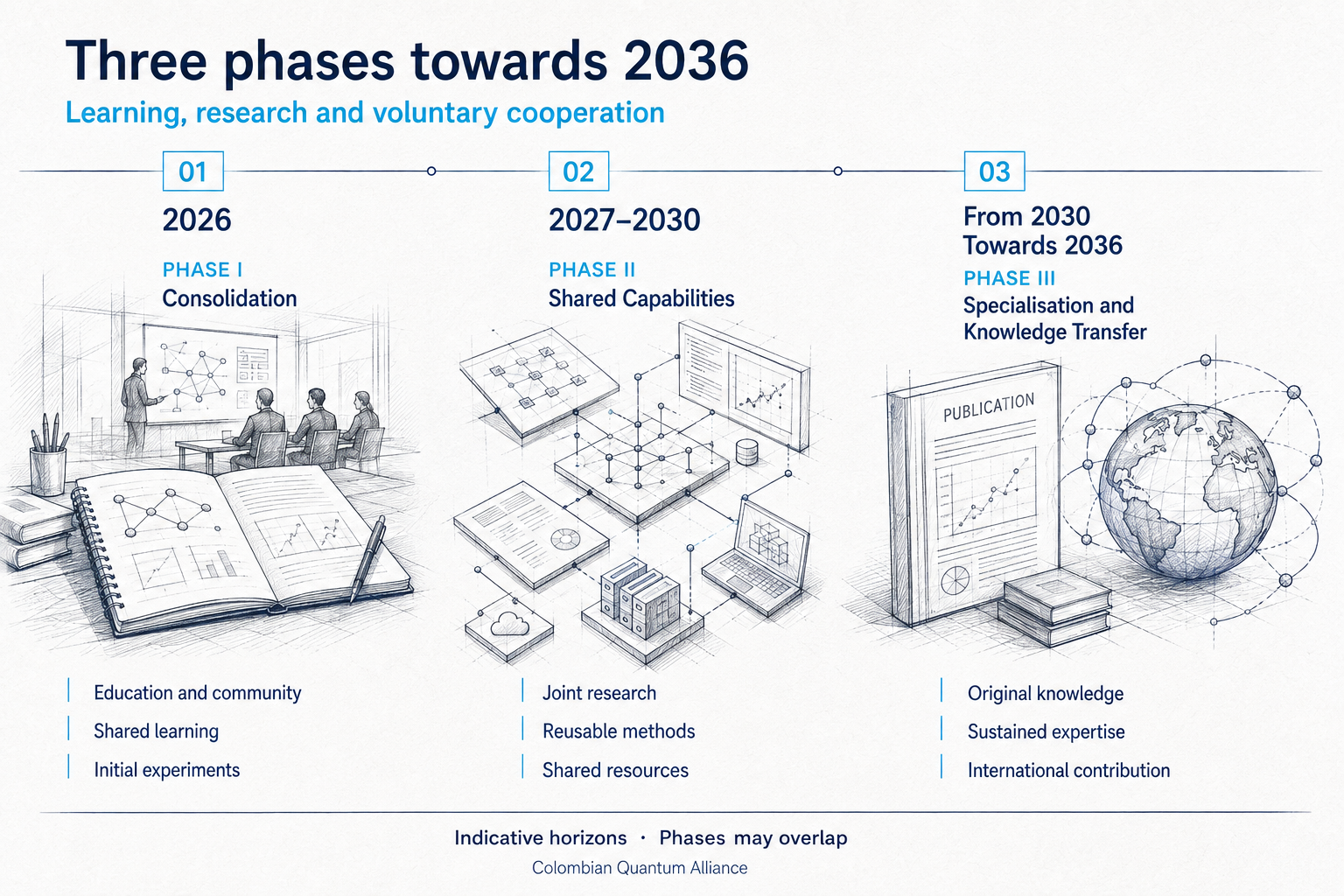
Our roadmap connects community development with increasingly sustained scientific contributions. Its dates are indicative horizons. Activities may overlap, and progress depends on shared interest, experience, and the resources available to the teams involved.
Phase I — Consolidation | 2026
Purpose: strengthen the community and its foundations for learning and cooperation.
We build on existing educational activities, support scientific encounters, share materials, and connect people with complementary interests. Initial experiments and discussions help participants understand tools, research questions, and opportunities for collaboration.
Our role is to facilitate these connections and support contributions that participants can sustain. Progress is visible when people find useful interlocutors, access learning opportunities, share experience, and continue working together.
Phase II — Shared Capabilities | 2027–2030
Purpose: turn established relationships into deeper collaboration and reusable knowledge.
Interested teams can develop joint research, teaching resources, and experimental workflows. Where expertise, agreements, and resources allow, projects may explore access to computing infrastructure or integration between classical and quantum tools.
Regional and international collaborators can contribute complementary knowledge. Each project defines its own scientific questions, responsibilities, and resource needs. Sharing methods, documenting experiments, and comparing results appropriately can help knowledge circulate beyond the original team.
Progress means that collaboration becomes easier to continue and that its outputs become useful to other researchers, educators, or participating organisations.
Phase III — Specialisation and Knowledge Transfer | From 2030, towards 2036
Purpose: develop sustained areas of expertise and contribute original knowledge to the wider QIS community.
Specialisation should emerge from the work participants develop and the questions they are equipped to investigate. Contributions may include fundamental research, algorithms, educational resources, software, evaluation methods, or collaborations on applications.
Knowledge transfer can take the form of publications, teaching, shared tools, research partnerships, or application-specific collaboration. Ventures and commercial opportunities may emerge where the evidence and conditions support them.
Progress means that Colombian participants contribute work that others can examine, use, and build upon, supported by relationships and expertise that endure.
Contribute to the next step
CQA grows through contributions that people are willing and able to make: sharing a scientific question, supporting a learning activity, discussing a research problem, offering technical experience, or connecting colleagues with complementary interests.
Together, these contributions build the foundations for Colombia’s participation in Quantum Information Science.
Connect with the alliance: quantum@cybercolombia.org
Research and strategy background
- Tenjo-Patiño, Bello, and Montoya. Quantum Computing Education in Latin America: Experiences and Strategies.
- Bello and colleagues. Quantum Ecosystem Research and Analysis in Colombia.
- Iniciativa Mexicana en Tecnologías Cuánticas (2023).
- Chile, Estrategia Nacional de Tecnologías Cuánticas 2025–2035 (PDF).
- Núñez-Corrales. Condiciones y Oportunidades para América Latina en el Ecosistema de Tecnologías Cuánticas, Quantum Latino (2023; conference programme).
- Heikkinen, Núñez-Corrales, and Stirbu. Navigating the Socio-Technical Complexity Challenge in Quantum Software Ecosystems.
- Munich Quantum Valley. Munich Quantum Software Stack.
Last reviewed: September 2026.